
Amazon Web Services
AWS Deployment
Section titled “AWS Deployment”Running ARROW on AWS means uploading a disk image, importing it as an EBS snapshot, registering that snapshot as an AMI, and launching instances from it. Your AWS build downloads as a ZIP containing the disk image and arrow-deploy, a single tool that does all of it.
What is in the download
Section titled “What is in the download”| File | What it is |
|---|---|
*.vmdk | The disk image, stream-optimized, around 23 GB |
arrow-deploy-linux-amd64 | The deploy tool for Linux |
arrow-deploy-darwin-arm64 | The deploy tool for macOS (Apple silicon) |
arrow-deploy-windows-amd64.exe | The deploy tool for Windows |
*-deployment.txt | A summary of this build and the manual commands |
DEPLOY-README.txt | Quick reference |
import-to-aws.sh, Import-To-AWS.ps1 | The previous scripts, still included during the transition |
Prerequisites
Section titled “Prerequisites”You need the AWS CLI, credentials (aws configure), and a default region. Two further things are required once per account, and arrow-deploy offers to create both:
- An S3 bucket to stage the disk image during import.
- The
vmimportIAM role. AWS VM Import/Export assumes this role to read your bucket and register the AMI. It is account-wide and AWS will not import anything without it.
Check everything before you start
Section titled “Check everything before you start”doctor verifies your prerequisites and creates nothing:
chmod +x arrow-deploy-linux-amd64./arrow-deploy-linux-amd64 doctor --cloud aws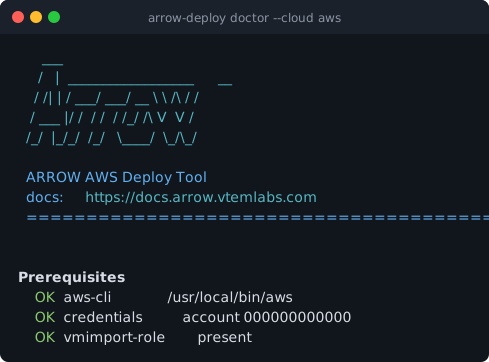
If the vmimport role is missing, doctor says so and import offers to create it for you, with a policy scoped to just your staging bucket.
Deploy
Section titled “Deploy”Step 1: Import the disk image
Section titled “Step 1: Import the disk image”./arrow-deploy-linux-amd64 import \ --cloud aws \ --image kali-arrow-yourclient-aws.vmdk \ --image-name arrow-kaliWith no --bucket, the tool lists your buckets to choose from, and offers to create one if you have none. It then uploads the image, imports it as an EBS snapshot, and registers an AMI. The AMI id is printed at the end.
The snapshot import is the slow part and runs entirely inside AWS. Expect it to take longer than the upload.
Step 2: Launch an instance
Section titled “Step 2: Launch an instance”./arrow-deploy-linux-amd64 launch \ --cloud aws \ --image-id ami-xxxxxxxxxxxxxxxxx \ --vm-name arrow-kali-01 \ --size t3.xlarge \ --ssh-key my-key-pairThe tool offers an instance type and one of your EC2 key pairs if you do not pass them, and prints the instance’s public address when it is ready.
Step 3: Sign in
Section titled “Step 3: Sign in”The instance has two separate accounts, reached by different means.
| Account | How you get in | Password |
|---|---|---|
kali | Your EC2 key pair | No password; key only |
arrow | Password | Unique to this VM, shown in the ARROW Portal |
Your key pair is injected by cloud-init into the distribution’s default user, which is kali on a Kali image. It is not injected into the arrow account.
ssh -i my-key.pem kali@<instance-address>The arrow account is for console access and manual configuration using the password from the Portal. Most of the time you do not need to sign in at all, because the instance connects back to ARROW on its own as soon as it has network access.
The instance keeps its ARROW name
Section titled “The instance keeps its ARROW name”A deployed instance’s hostname is the name shown on its device record in the ARROW Portal, not the EC2 instance name or tag. This is deliberate, because the Portal name is the identity your team works with, so the image keeps it.
Removing what you created
Section titled “Removing what you created”cleanup reports what it would remove and deletes nothing until you add --yes:
./arrow-deploy-linux-amd64 cleanup --cloud aws./arrow-deploy-linux-amd64 cleanup --cloud aws --yesIt terminates instances, deregisters AMIs, and deletes the EBS snapshots behind them. Only resources it created are touched, identified by its own tag; narrow it further with --name-prefix.
The staged copy of your disk image in S3 is deleted automatically once the import succeeds, since AWS has copied it into the snapshot by then.
Command reference
Section titled “Command reference”Commands
Section titled “Commands”| Command | What it does |
|---|---|
doctor | Checks prerequisites, creates nothing |
import | Uploads the image, imports a snapshot, registers an AMI |
launch | Creates an EC2 instance from an AMI |
cleanup | Removes instances, AMIs and their snapshots |
version | Prints the version |
Flags used with AWS
Section titled “Flags used with AWS”| Flag | Applies to | Meaning |
|---|---|---|
--cloud aws | all | Target cloud, always required |
--image | import | Path to the .vmdk |
--image-name | import | Name to register the AMI under |
--bucket | import | S3 bucket used to stage the upload |
--image-id | launch | The AMI id that import printed |
--vm-name | launch | Name tag for the instance |
--size | launch | Instance type, for example t3.xlarge |
--ssh-key | launch | Name of an EC2 key pair in your account |
--security-group | launch | Existing security group to attach |
--subnet | launch | Subnet to launch into |
--name-prefix | cleanup | Restrict cleanup to matching names |
--yes | cleanup | Actually delete; without it cleanup only reports |
Flags available everywhere
Section titled “Flags available everywhere”| Flag | Meaning |
|---|---|
--dry-run | Report what would happen without changing anything |
--json | Machine-readable output, for scripting |
--non-interactive | Never prompt; every value must be supplied as a flag |
--no-color | Disable coloured output. NO_COLOR is also honoured |
Under --non-interactive the tool creates no IAM role and no security group. It prints the exact commands to run instead.
Recommended instance types
Section titled “Recommended instance types”| Type | vCPU / RAM | Use |
|---|---|---|
t3.large | 2 / 8 GB | Minimum |
t3.xlarge | 4 / 16 GB | Recommended for most work |
m5.2xlarge | 8 / 32 GB | Heavier workloads |
Troubleshooting
Section titled “Troubleshooting”doctor reports the vmimport role missing. Run arrow-deploy import --cloud aws and accept when it offers to create it, or create it yourself following the AWS VM Import permissions guide.
doctor reports no usable credentials. Run aws configure, and set a default region while you are there.
The instance is running but SSH times out. Its security group almost certainly does not allow inbound SSH from your address. Attach one that does, or let arrow-deploy launch create one.
SSH is refused with “Permission denied (publickey)”. Check which user you are signing in as. The key pair goes to the distribution’s default user, kali on a Kali image, not to arrow.
The import fails with a disk format error. ARROW builds a stream-optimized VMDK, which is what VM Import requires. Re-download the artifact if it may have been altered or truncated in transit.
A snapshot is still billing after cleaning up in the console. Deregistering an AMI does not delete its snapshot. Delete it explicitly, or use arrow-deploy cleanup --yes, which does both.
Previous deploy scripts
Section titled “Previous deploy scripts”import-to-aws.sh and Import-To-AWS.ps1 are still included in the download and still work:
chmod +x import-to-aws.sh./import-to-aws.sh # import the VMDK./import-to-aws.sh --launch # launch from an existing ARROW AMI./import-to-aws.sh --cleanup # remove ARROW resourcesNew deployments should use arrow-deploy. It is the same flow on every platform, it supports --dry-run and --json, it removes the snapshot and staged object that the scripts leave behind, and it rolls back what it created if something fails partway.